
Tenant Screening in Japan for Foreigners: What Landlords Ask and Why Applications Get Rejected (2026)

Quick answer: when you apply for an apartment in Japan, the landlord, the management company and usually a rent guarantor company all check you before saying yes. This check is called nyūkyo shinsa (入居審査). For foreign applicants, the first questions are often your nationality, how much Japanese you speak, and whether you are on a student or a work visa. Income, job stability and who will live with you come next. Applications are most often turned down for weak income, a short or unclear visa period, a guarantor company rejection, missing basics like a Japanese phone number or bank account, or simply because the landlord does not want foreign tenants. Below is what is checked, which documents to prepare, and what to do if you are rejected.
An important distinction: this article describes the questions applicants actually run into, not what screening ought to be. Nationality-based assumptions are not fair, and they are not a reliable guide to how anyone will live in an apartment. Income, the ability to pay rent, who will live there and whether you will follow the lease should be judged on your own application, and that is what you can prepare for.
What Is Tenant Screening in Japan, and Who Does It?
In many countries a landlord looks at your credit score and references and makes one decision. In Japan, two or three parties usually look at your application separately, and any one of them can stop it.
| Who | What they decide |
|---|---|
| Landlord (大家, ōya) | Whether they want you as a tenant at all. This is where nationality, language and lifestyle questions come in. |
| Management company (管理会社) | Whether your documents are complete and your income fits the rent. Many landlords leave the first check to them. |
| Rent guarantor company (保証会社) | Whether they will cover your rent if you stop paying. They run their own check, separate from the landlord. |
The real estate agent you deal with sends your application to these parties and passes their questions back to you. In my experience, screening takes about 10 days at the shortest, and longer if the landlord asks for more documents or the guarantor company needs to call your employer or emergency contact. Being approved by the landlord does not mean you are finished: you may still be waiting for the guarantor company.
What Do Landlords Ask Foreign Applicants?
Here is how it usually works. You find an apartment you like and tell the agent you want to apply. Before taking your documents, the agent often phones the landlord or the management company to ask whether they would consider you. On that call, three questions come up again and again in my experience: which country you are from, how much Japanese you speak, and whether you are on a student visa or a work visa. I have stood at agency counters while the agent made that call, and those were the questions on the other end of the line.
For example, the landlord might ask, “Where is the applicant from? Can they speak Japanese? What kind of visa do they have?” and the agent answers something like, “She is from Canada, speaks some everyday Japanese, and has a work visa valid for three more years with an IT company in Shibuya.” If the landlord is comfortable with those answers, your application goes ahead. After that come the usual checks that every applicant faces.
- Nationality. Some landlords simply ask; a few have already decided which nationalities they will not accept (more on this below).
- Japanese ability. The landlord wants to know whether they or the management company can explain the building rules, garbage days and repairs to you, and whether you can understand the contract.
- Visa type and how long it is valid. A work visa with time left on it reassures a landlord more than a student visa that ends in a few months, because the lease normally runs for two years.
- Job and income. Your employer, how long you have worked there and your annual income. A common rule of thumb is that rent should be no more than about one third of your monthly income. That is a screening habit, not a law: some companies look at gross pay, others at take-home pay, savings or how long you have been employed, so ask your agent which standard the property uses.
- Who will live with you. Everyone moving in is usually named in the application. I have seen applications turned down where the contract holder was Japanese and only the person moving in with them was not.
- How you will use the room. Whether you will run a business from it, have frequent guests, or keep pets.
What Documents Do You Need for Tenant Screening?
Have these ready before you start viewing. An application that arrives complete on the first day is often the one that gets the apartment, especially from January to March when several people apply for the same room.
| Document | Notes |
|---|---|
| Residence card (在留カード) | Front and back. The landlord checks your visa type and expiry date. |
| Passport | The photo page. Some guarantor companies also ask for it. |
| Proof of employment or study | A certificate of employment (在籍証明書), job offer letter, or student ID / admission letter. |
| Proof of income | Recent payslips, last year’s withholding slip (源泉徴収票), or a tax certificate from your city office. New arrivals can often use the offer letter showing salary. |
| Japanese phone number | Guarantor companies call you and your emergency contact. See how to get a Japanese phone number. |
| Japanese bank account | Rent is usually paid by bank transfer or automatic debit. See opening a bank account in Japan. |
| Emergency contact | Many guarantor companies want someone in Japan; some also ask for a family member in your home country. |
Get the phone number and the bank account first. These are not legal requirements, and no rule says a landlord must see them, but in my experience, an application without them usually cannot even go to screening, and the few agencies that accept applicants who are still setting them up have far fewer apartments to offer. If you are self-employed, the list is different; our guide to renting as a freelancer explains which tax documents landlords ask for. If you are not sure how to read your own payslip, this payslip guide helps.

Why Do Rental Applications Get Rejected in Japan?
A rejection usually comes with no explanation, which is frustrating. These are the most common reasons, based on published surveys and on what applicants run into in practice.
- The landlord does not want foreign tenants. This still happens. In a Ministry of Justice survey of about 4,250 foreign residents carried out in 2016 and published in 2017, about 39% of those who had looked for housing in the previous five years said they had been refused because they were foreign. That is a historical survey result, not today’s rejection rate for every application, but it shows the problem is widespread (source: Toyo Keizai report on the survey).
- Income does not match the rent. If the rent is well above one third of your monthly income, many landlords and guarantor companies will say no, whatever your nationality.
- Visa period or job looks unstable. A visa that expires soon, a new job still in probation, or contract and part-time work can all count against you.
- The guarantor company says no. They may not tell you why. Past late payments on a phone plan or credit card can matter if the company checks credit records. See our guide to rent guarantor companies.
- Missing basics. No Japanese phone number, no bank account, or no emergency contact in Japan.
- Who is moving in. Sharing with friends rather than family, or more people than the room is meant for, makes some landlords nervous.
Not sure how your application will look to a landlord? Ask Aikagi. Send us your situation and get a written answer within five business days (¥5,000), or book a 45-minute online call (¥10,000). Sending your question is free; you pay only after we confirm we can help.
The Worries Behind the Questions: Noise, Cooking Smells and Subletting
It helps to know what a nervous landlord is actually afraid of, because you can answer those fears directly. Most of it comes down to three things. None of them is specific to foreign tenants: noise, cooking, guests and subletting can be an issue in any rental, whoever lives there. Some landlords apply stereotypes to foreign applicants, but a stereotype is not evidence of how you will behave.
- Noise and smells. Japanese apartments are close together and walls are thin. Some landlords worry that a foreign tenant will be louder, have more guests, or cook with strong spices whose smell stays in the walls and spreads to the corridor. In practice this worry is often attached to particular nationalities rather than to the person applying. That is a stereotype, and it is unfair, but it is real enough that you will run into it.
- Rules they cannot explain. Garbage sorting, quiet hours and what you may put on the balcony are the most common sources of neighbour complaints, and the landlord worries about who will explain them to you. See our garbage sorting guide.
- Subletting and short-term rentals. Landlords have seen rooms turned into Airbnb-style rentals or quietly passed to other people. This is the reason behind some of the strictest contract terms (next section).
If a landlord has questions about your application, ask the agent what the actual lease requirements are, and give the relevant information: who will live there, how you will use the apartment, and that you understand the building rules. These are ordinary tenancy matters that apply to every tenant, not extra obligations for foreign applicants. An agent can pass this on in Japanese, and clear answers do change some decisions.
What Strict Contract Terms Might You See?
Even after you are approved, the contract may be stricter than you expect. Read these parts carefully, or ask your agent to explain them.
| Term | What it means for you |
|---|---|
| No subletting (転貸禁止) | Under Japan’s Civil Code (Article 612) you cannot sublet or hand over the room without the landlord’s consent, and most contracts repeat this. Letting a friend move in, or renting the room out while you travel, can be a breach. |
| No short-term rental use (民泊禁止) | Many contracts now ban using the room for Airbnb-style stays outright. A Tokyo District Court decision in 2019 upheld a landlord’s termination of a lease after a tenant’s short-term rental use caused complaints from neighbours. |
| Named occupants only | Only the people listed on the contract may live there. Adding a partner or roommate later usually needs the landlord’s approval. |
| Residential use only | Running a business, storing stock or seeing clients at home may be prohibited. |
| Cleaning and restoration at move-out | Professional cleaning fees and who pays for what damage. At move-out, cleaning and garbage are what tenants and landlords argue about most often. |
None of these clauses are aimed at foreigners specifically; Japanese tenants sign the same terms. But because some landlords assume foreign tenants are more likely to sublet, the clauses may be stricter, or explained more firmly, when the tenant is foreign. If something in the contract is unclear, ask before you sign, not after.
How Can You Improve Your Chances of Passing?
- Set up your Japanese phone number and bank account before you start viewing.
- Prepare all documents in one folder, scanned, so you can apply the same day you like a room.
- Choose rent you can comfortably cover, roughly a third of your monthly income or less.
- Tell the agent everything upfront: visa period, who will live with you, pets, and whether you work from home. Surprises later are the most common way a nearly approved application falls apart.
- Ask the agent to search for buildings whose landlords already rent to international tenants. Good agents know them, and it saves you viewings that would end in a no.
- If your Japanese is limited, say so honestly and mention any support you have, such as an employer or school that can help with paperwork.
- If your moving dates are flexible, consider searching outside the January to March peak. Competition is lower for some properties then, although each landlord still decides in their own way.
What Should You Do If Your Application Is Rejected?
A rejection does not mean you cannot rent in Japan. Ask your agent whether the decision came from the landlord or the guarantor company. They may not know the reason, or may not be allowed to tell you, but knowing which party said no tells you what to try next.
- Guarantor company said no: the agent may be able to try a different guarantor company that uses different checks.
- Landlord said no: move on to a building whose landlord already accepts foreign tenants. Arguing with one landlord rarely changes the outcome.
- Income was the issue: look at a lower rent, or ask whether extra documents such as savings or an employer letter would help.
- A share house in the meantime: share houses usually have simpler screening and lower move-in costs. See our share house guide.
If you believe you were refused only because of your nationality, you can ask the agent for an explanation and get advice from the Ministry of Justice’s foreign-language human rights consultation line: 0570-090911 (weekdays 9:00 to 17:00, in English, Chinese, Korean, Vietnamese and several other languages; source: Minato City). The national government also publishes guidelines (Japanese) asking landlords and agents to help foreign residents rent smoothly, so this is a recognised problem, not something you have to accept quietly.
If you suspect discriminatory treatment: keep copies of the listing, your application messages and any explanation you were given, and ask the agent whether the reason can be confirmed in writing. The hotline above gives advice; it cannot make a landlord approve your application, but it can tell you what options you have.
Tenant Screening in Japan: Frequently Asked Questions
Q How long does tenant screening take in Japan?
In my experience, about 10 days at the shortest. It can take longer if the landlord asks for extra documents, if the guarantor company cannot reach you or your emergency contact by phone, or during the January to March rush.
Q Can a landlord in Japan refuse me because I am a foreigner?
It still happens, and close to 40% of foreign residents who had looked for housing reported it in a 2016 Ministry of Justice survey. It is treated as a human rights issue, and you can get advice from the foreign-language human rights line (0570-090911). In practice, the fastest route is usually to focus on landlords who already accept international tenants.
Q Do I need to speak Japanese to rent an apartment?
No, but the landlord will ask. What they want to know is whether someone can explain the building rules and the contract to you. If an agent, employer or school can support you in Japanese, say so.
Q Can I rent an apartment on a student visa?
Yes, many students do. Expect more questions about how long you will stay and who pays the rent, and a guarantor company will usually be required. A family member or school may be asked to act as an emergency contact.
Q Can I let a friend stay or rent my room on Airbnb while I travel?
Not without the landlord’s written consent. Most leases ban subletting and short-term rental use, and breaking those terms can lead to the contract being terminated. Short visits from friends are normally fine, but check your contract if someone will stay for a long time.
Q What happens after I pass screening?
You sign the contract, pay the move-in costs, and receive the keys on the start date. Our guide to Tokyo rent and move-in costs explains what you will pay at this stage.
Screening rules differ between landlords and companies and can change, so treat this as general guidance and confirm the details with your agent.

How to Find Your Ideal Rental in Tokyo
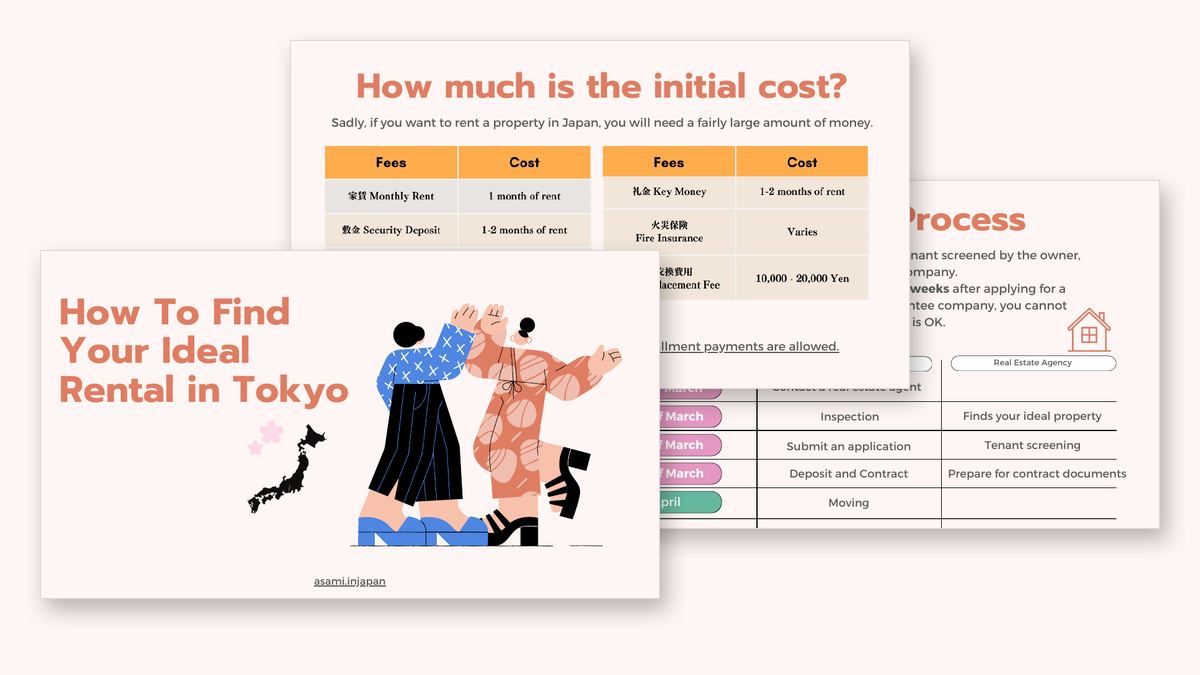
A 15-page guide by Aikagi: the move-in schedule week by week, the documents you need to apply, and what the initial costs add up to (updated October 2026). Add Aikagi on LINE and we’ll send it to you for free.
Looking for an apartment in Japan?
Not sure whether your application will pass?
Aikagi helps foreign residents find apartments in plain English. We check with landlords before you visit and present your application in a way they can assess.